
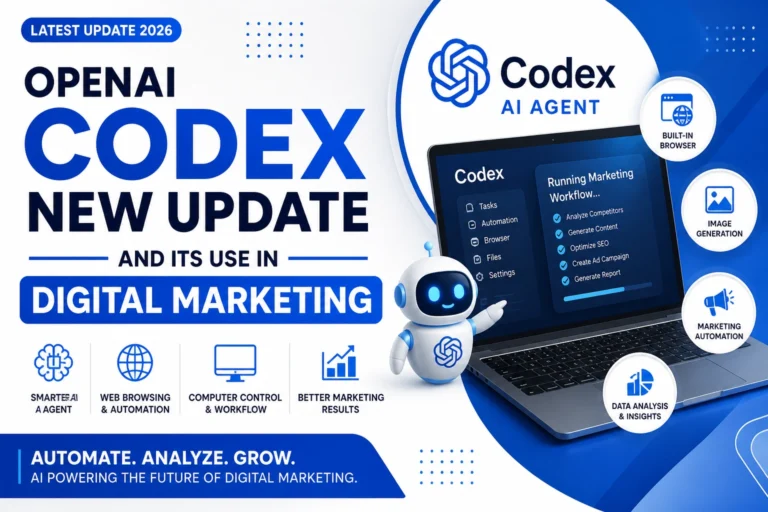
The Latest OpenAI Codex Update and Its Impact on Digital Marketing
In 2026, OpenAI’s Codex has evolved far beyond a simple code-writing assistant. With its latest update, Codex is now positioned as a powerful AI agent capable of handling complex workflows, automating tasks, and even interacting directly with computer systems. This transformation is not just significant for developers it is also reshaping industries like digital marketing.
What Is Codex in 2026?
OpenAI Codex is no longer limited to generating code from natural language. It has become a full-fledged AI agent that can execute tasks, manage workflows, and assist across tools and platforms. Unlike traditional AI chat tools that focus on conversation, Codex is designed to perform real work independently.
The latest update introduces several advanced features, including computer control, memory, automation, and integrated browsing. These upgrades make Codex capable of functioning like a virtual assistant that can actively complete tasks instead of just suggesting solutions.
Key Features of the Latest Codex Update
1. Computer Control and Automation
One of the most groundbreaking updates is Codex’s ability to interact with computer systems. It can click, type, navigate applications, and execute tasks across software environments.
This means users can assign tasks such as setting up campaigns, organizing files, or managing workflows without manual effort.
2. Memory and Context Awareness
Codex now remembers user preferences, past tasks, and workflows. This allows it to deliver more personalized and efficient outputs over time.
For digital marketers, this means the AI can learn brand voice, campaign style, and audience preferences.
3. Built-in Browser and Web Interaction
With integrated browsing capabilities, Codex can gather information, analyze websites, and interact with online platforms directly.
This is particularly useful for market research, competitor analysis, and SEO tasks.
4. Background Task Execution
Codex can run tasks in the background and continue working without constant supervision. It can also schedule tasks and complete long workflows automatically.
This enables continuous productivity, even when the user is offline.
5. Image Generation and Creative Support
The latest update includes image generation capabilities for creating visuals, mockups, and marketing assets.
This is a major advantage for marketers who need quick creative outputs.
How Codex Is Transforming Digital Marketing
The new capabilities of Codex are opening up powerful opportunities in digital marketing. Here are some key use cases:
1. Content Creation at Scale
Codex can generate blog posts, ad copy, email campaigns, and social media content efficiently. More importantly, it can adapt content based on brand tone and audience preferences using its memory feature.
For example, a digital marketer can instruct Codex to:
- Write SEO blog posts
- Generate Instagram captions
- Create email marketing sequences
This reduces content creation time significantly.
2. SEO Optimization and Website Management
Codex can analyze websites, suggest improvements, and even implement technical SEO changes. Since it can interact with systems, it can:
- Fix on-page SEO issues
- Optimize meta tags
- Improve site structure
This bridges the gap between marketing and technical SEO.
3. Marketing Automation
With background task execution, Codex can automate repetitive marketing tasks such as:
- Scheduling social media posts
- Managing email campaigns
- Updating CRM systems
This allows marketers to focus more on strategy rather than manual work.
4. Data Analysis and Reporting
Codex can collect and analyze data from multiple sources, generate reports, and provide actionable insights.
For instance, it can:
- Analyze campaign performance
- Track engagement metrics
- Suggest optimization strategies
This improves decision-making and campaign efficiency.
5. Ad Campaign Creation and Optimization
Codex can assist in creating and optimizing paid ad campaigns. It can:
- Generate ad creatives
- Test multiple variations
- Optimize targeting strategies
With automation, marketers can run more experiments and improve ROI.
6. Competitor and Market Research
Using its browsing capabilities, Codex can gather real-time insights about competitors and market trends.
It can:
- Analyze competitor websites
- Identify trending keywords
- Suggest content strategies
This helps businesses stay ahead in competitive markets.
Benefits for Digital Marketers
The latest Codex update provides several advantages:
- Time Efficiency: Automates repetitive tasks
- Cost Reduction: Reduces need for large teams
- Scalability: Enables handling multiple campaigns simultaneously
- Accuracy: Minimizes human errors in execution
- Productivity: Works continuously without fatigue
These benefits make Codex a valuable tool for both freelancers and agencies.
Challenges and Considerations
Despite its capabilities, Codex is not perfect. It still requires human oversight, especially for strategic decisions and quality control. AI-generated content must be reviewed to ensure accuracy, relevance, and brand alignment.
Additionally, over-reliance on automation can reduce creativity if not managed properly. Marketers should use Codex as a support tool rather than a complete replacement.
Conclusion
The latest update of OpenAI Codex marks a significant shift from AI assistance to AI execution. With features like computer control, memory, automation, and integrated browsing, Codex is becoming a powerful partner in digital marketing.
For marketers, this means faster workflows, smarter campaigns, and greater efficiency. However, success will depend on how effectively professionals combine AI capabilities with human creativity and strategic thinking.
In the coming years, digital marketing will not just be about skills it will be about how well you can collaborate with AI tools like Codex to deliver better results.